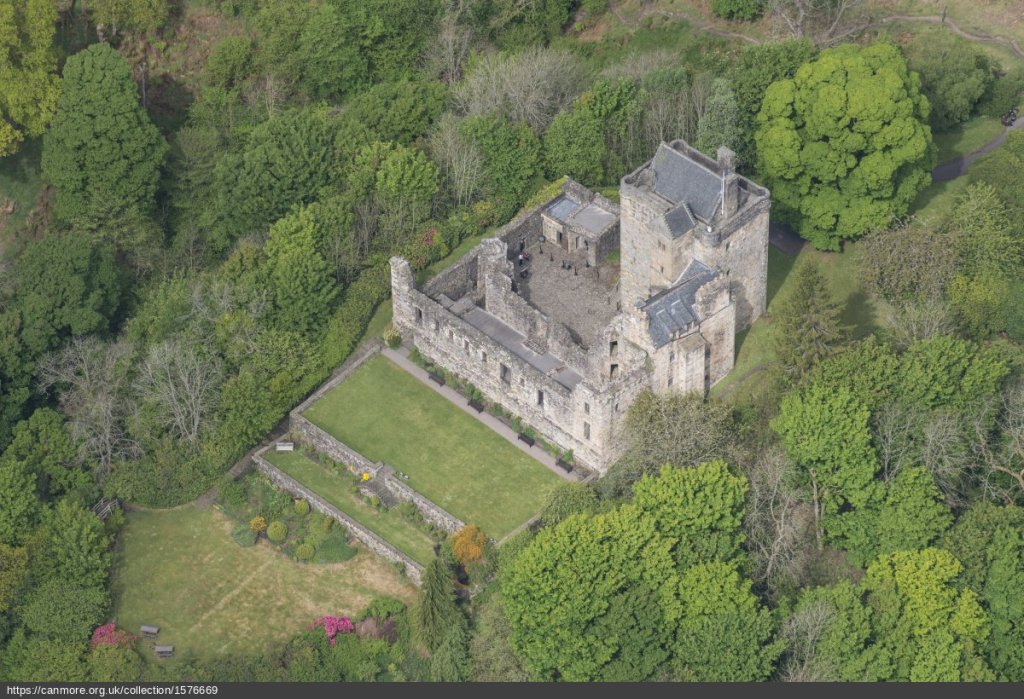
Castle Campbell sits high in the Ochil Hills with commanding views over the Forth Valley to the south and makes a rewarding stop on a short hike through Dollar Glen. The castle, not far from Stirling, became the Lowland seat of the powerful Campbell earls of Argyll in the mid-15th century, though its origins date to a motte castle from the 12th or 13th century. The castle began to take on its current shape with the building of a tower house, probably by John Stewart, Lord of Lorn, in the early 15th century. Lorn died without sons so his son-in-law, Colin Campbell, Earl of Argyll, used his marriage to Lorn’s eldest daughter to claim the castle in 1466.
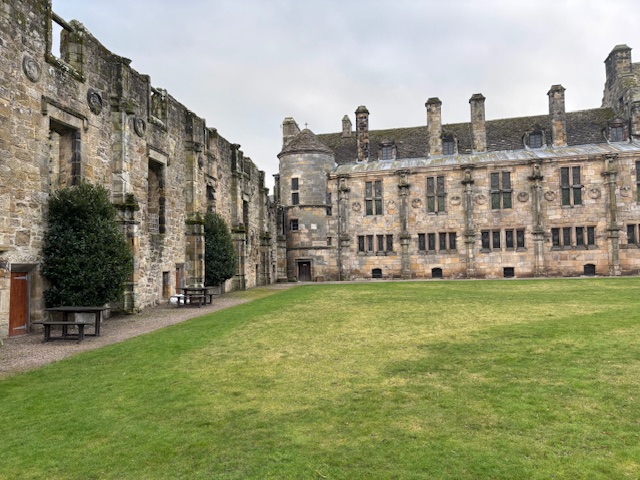
The picturesque Fife village of Falkland is dominated by the Renaissance palace that shares its name. The palace and gardens are managed by the National Trust for Scotland and make a great destination for a day out from Tigh a’ Mhaide. The palace was a favourite royal playground where Scotland’s kings and queens hunted and relaxed. More recently, the palace and Falkland village featured in the TV series Outlander, standing in for Inverness.
The medieval castle that preceded the palace at Falkland was a stronghold of the earls of Fife. It became the property of the Scottish crown in 1425 when Murdoch Stewart, earl of Fife at the time, was arrested, tried and executed for involvement in the gruesome murder of the heir to the throne. The murder victim was David, duke of Rothesay, who was thought to have been starved to death at Falkland by Murdoch’s father, Robert.
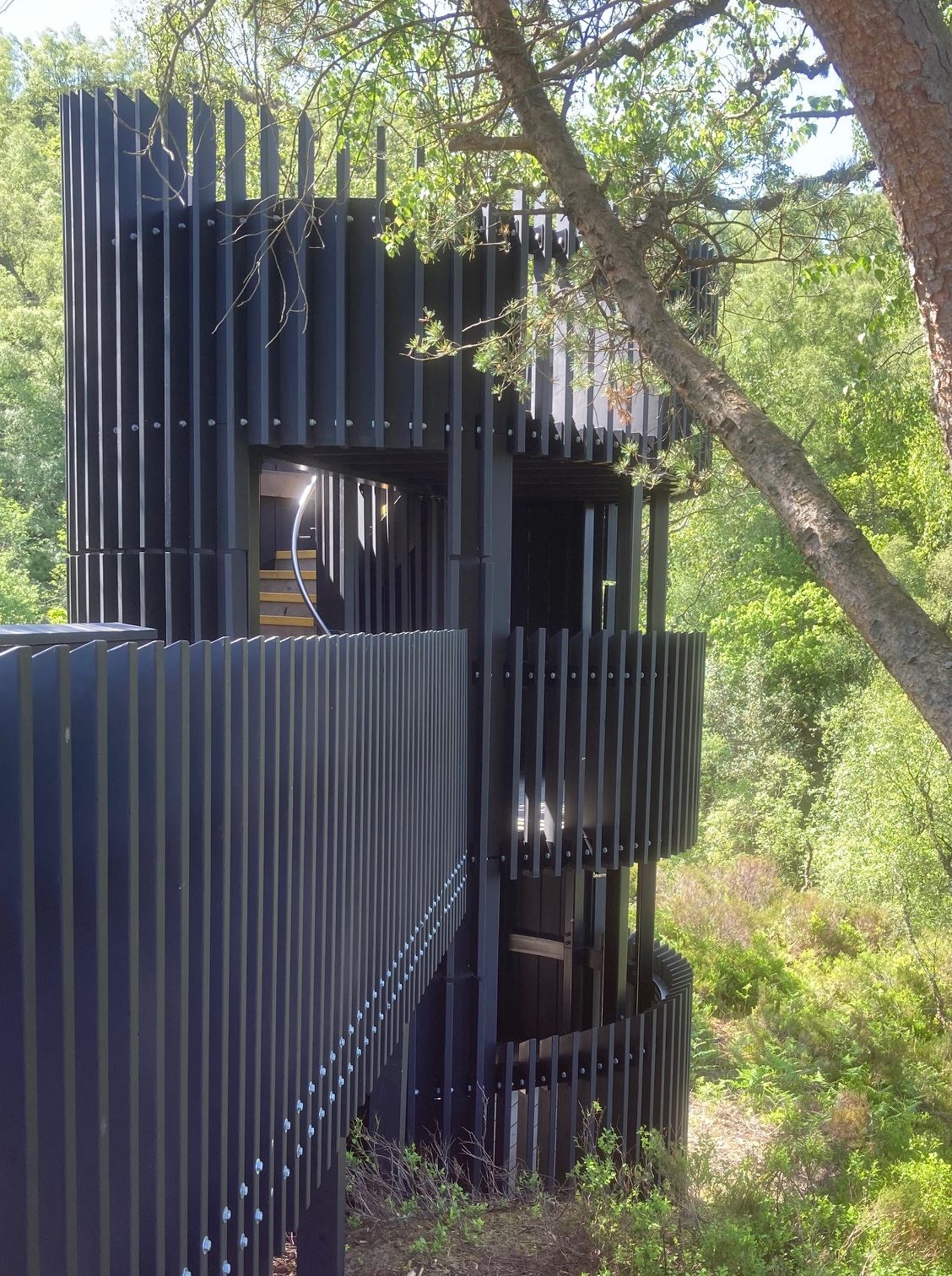
This summer was my first opportunity to visit the new lookout tower at Loch Katrine. I had the good fortune to be there on a beautiful day and it was well worth the short climb to the top. Built on three levels with information boards on the lower two and an open platform at the top for looking out over the loch and surrounding hills, the tower is near a viewpoint favoured by generations of visitors to Loch Katrine.
The tower is named after Roderick Dhu*, the fictional clan chief in the 1810 poem The Lady of the Lake written by Sir Walter Scott and often credited with starting tourism to Loch Katrine and The Trossachs. The tower stands on the site of a wicker hut built to shelter early tourists and intended to encourage artists and writers to visit and be inspired by the landscape.
A visit to the Library of Innerpeffray, near the Perthshire town of Crieff, is a must for history and book lovers. Founded around 1680 by David Drummond, third Lord Madertie, it is the oldest public lending library in Scotland. The library initially comprised Drummond’s personal collection of books which he stored in the 16th-century St Mary’s Chapel and made available to local people to borrow free of charge.
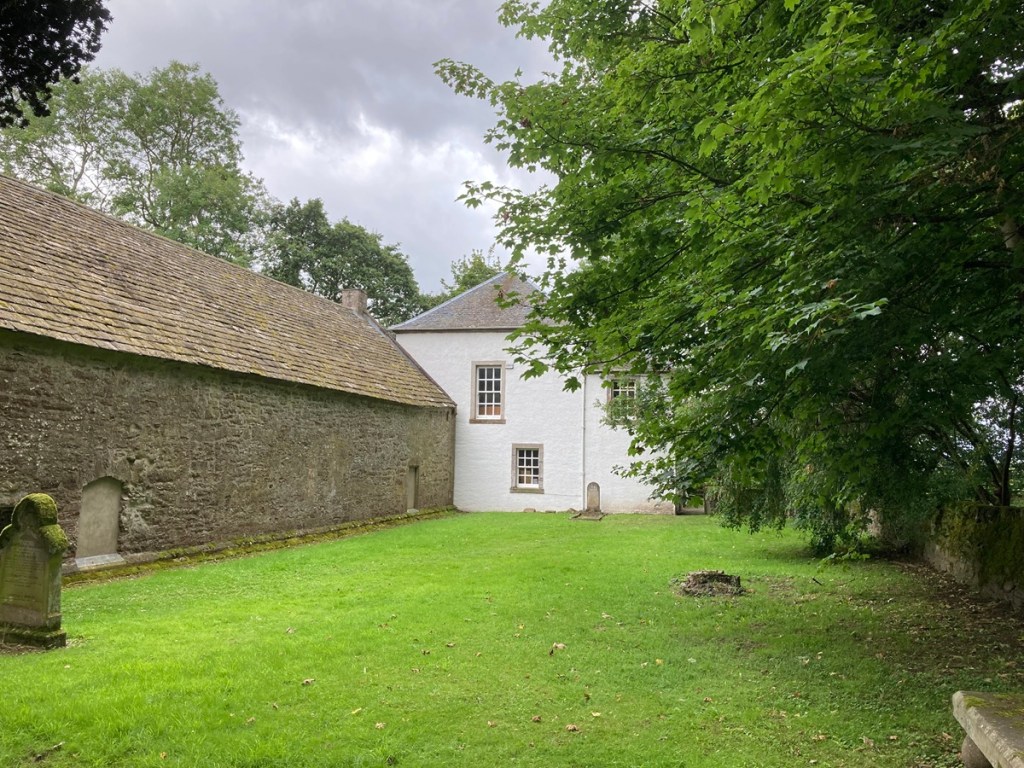
The original library was housed in St Mary’s Chapel (left) before moving to its current home in the purpose-built, adjacent building (centre).
In the mid-1700s, Robert Hay Drummond commissioned a new building for the library adjacent to the chapel and the books are housed there still. On a recent visit, we were greeted as we arrived by Lara Haggerty, Keeper of the Books, who explained the origins of the library, its expansion into the current building and some of the highlights of the collection. Before we started the tour, we got to choose a souvenir bookmark featuring woodcut illustrations from some of the collection’s 16th and 17th century books, and emboss it with the library’s stamp.
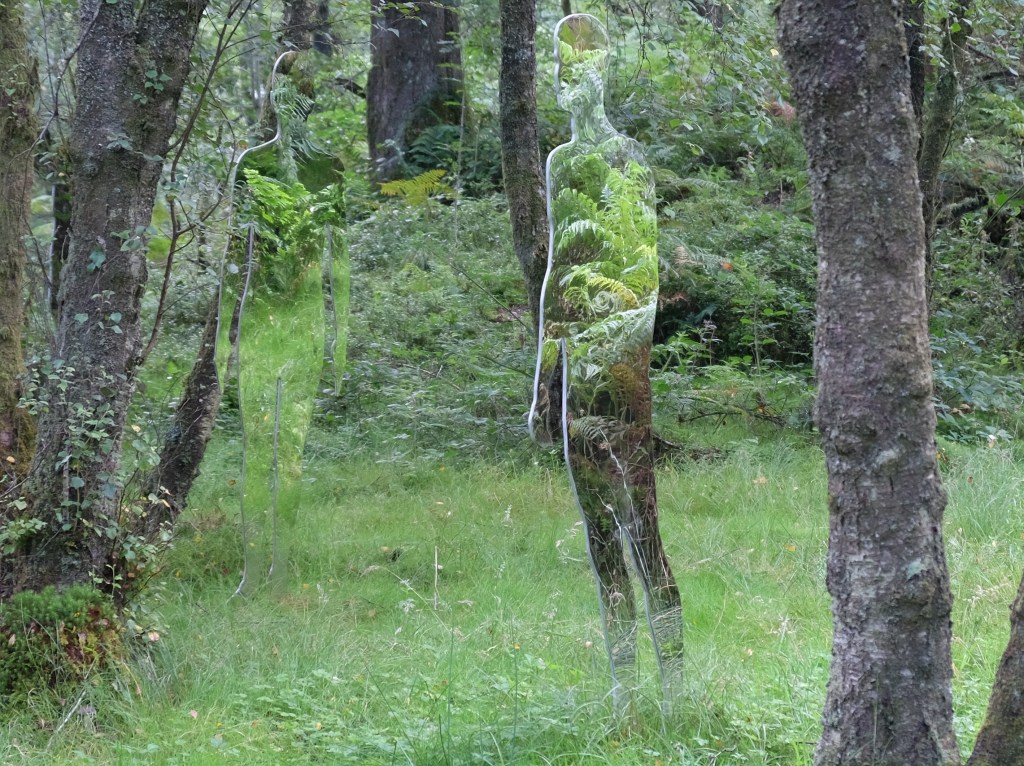
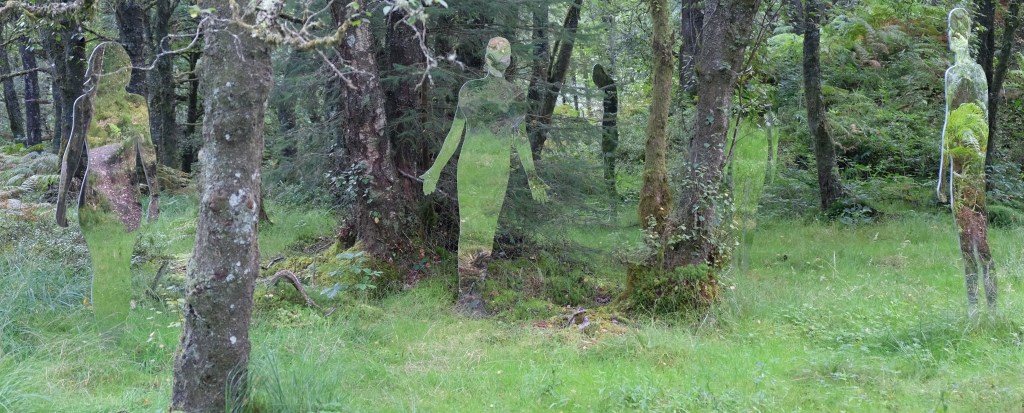
Walkers on the trails at the Forest Lodge Visitor Centre near Aberfoyle might be surprised to encounter some silent figures lurking among the trees. In fact, they are easy to miss but, once seen, are fascinating. They are the work of Scots sculptor Rob Mulholland and aim to encourage us to think about our relationship with both the natural and the man-made environment.
In 2009, Mr Mulholland created a series of six 1.8 metre high sculptures in polished stainless steel for temporary installation near what was then known as David Marshall Lodge.* The installation proved so popular, that Mr Mulholland was commissioned to create a further group of six, life-sized figures for permanent display. Describing the project on his website, the sculptor says: “Before the First World War, this area of Scotland was open hillside with small sheep farming crofts (farms) and rural communities. The crofters were moved to other land by the government as there was a desperate need for timber after the war. The area was planted with fast growing conifer trees suitable for harvesting softwood and the landscape altered once again. One can still see the faint outlines of the crofts and past settlements within the forest.”
How many figures are in this image?
It is these individuals, the previous residents of the area, that the sculptures represent. They stand quietly in the forest, reflecting the environment and sometimes passers-by. From some angles, they appear in outline, from others they merge into the background, barely distinguishable from the trees around them.
You can read more about these figures and Rob Mulholland’s other public art online here.
* The lodge was built by the Carnegie UK Trust in the 1950s based on the ideas of its chair David Marshall. The Trust gifted the Lodge to the Forestry Commission in 1960s but it continued to be known as David Marshall Lodge until 2013.
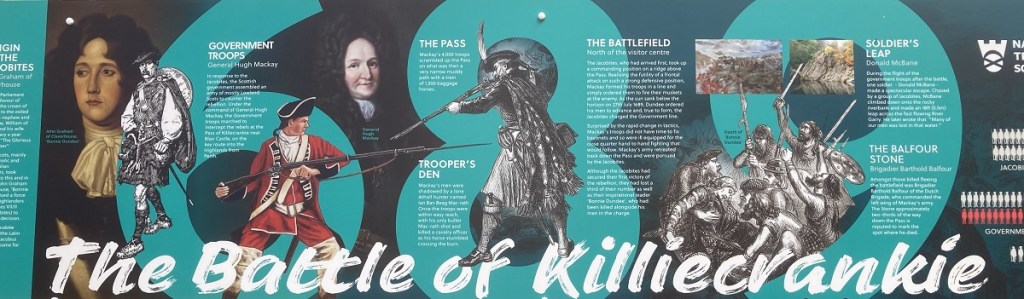
Today marks the 334th anniversary of the Battle of Killiecrankie. It was fought on July 27, 1689 between Jacobite forces led by John Graham of Claverhouse, first viscount Dundee* and government troops under Major-General Hugh Mackay. The battle was part of the Highland War that followed the overthrow of the Catholic king James VII of Scotland and II of England in favour of Protestant William of Orange and his wife Mary (James’s elder daughter). Heavily outnumbered, the Jacobite forces achieved an unexpected victory in the short battle that evening but Dundee was shot dead in the final stages. Without Dundee, the Jacobites were unable to replicate their success and were defeated the following month at Dunkeld, and although a fierce campaign of raid and counter-raid followed, the war ended in a truce in the summer of 1691.
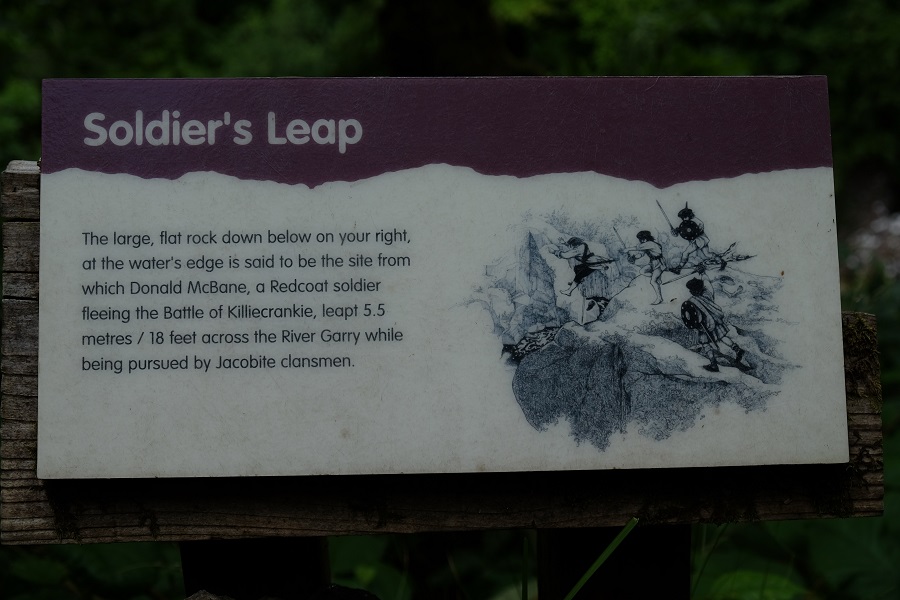
The Battle of Killiecrankie was the first major action in Scotland between supporters of the ousted King James (the Jacobites) and William of Orange’s army. Near the battle site, at the northern end of the Pass of Killiecrankie, a National Trust for Scotland visitor centre summarises the story. The main action took place about a mile from the visitor centre, across what is now the A9 main road from Perth to Inverness, but the narrow, deep gorge of the pass played an important role in the battle too as government soldiers advanced along it then fled back the same way, pursued by their Jacobite opponents.
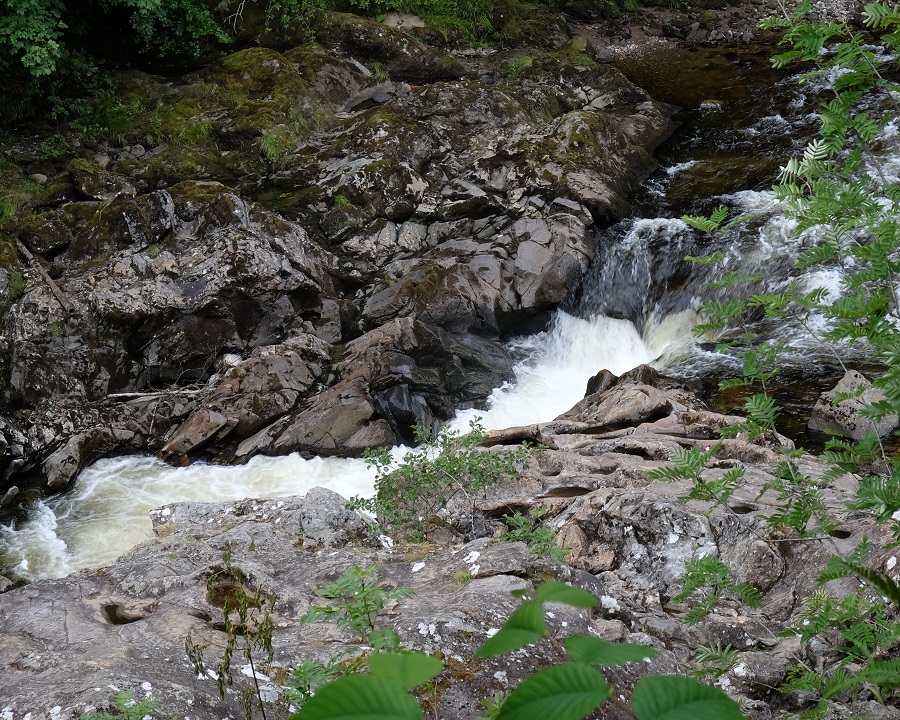
Imagine making this leap with enemy soldiers hot on your heels.
The river flowing through the Pass of Killiecrankie is the Garry and there are several riverside walks along the gorge which make for a lovely afternoon out amidst beautiful scenery. The pass is also a rich wildlife habitat and the National Trust has plenty of information at the visitor centre and along the routes about its conservation work.
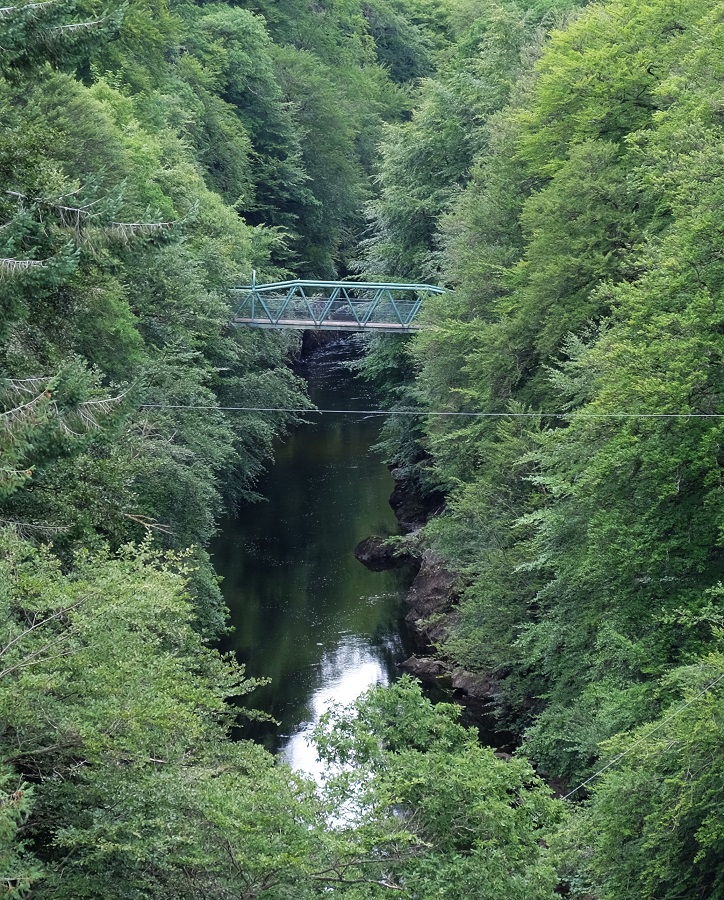
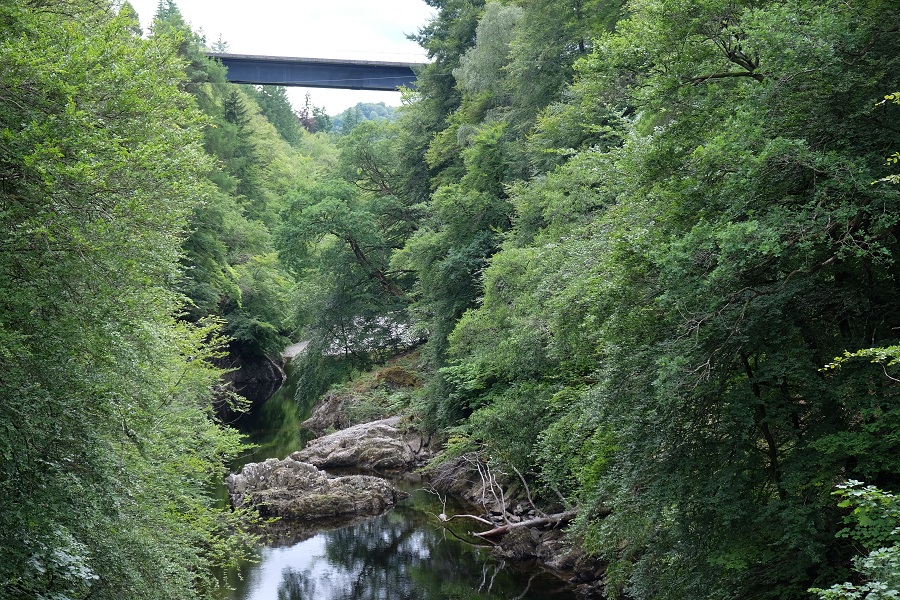
About two-thirds of the way along the pass, a green, metal footbridge spans the river. Looking north up the pass, the drop to the gorge floor seems huge but, turning to the south, the road bridge is even higher, emphasising the sheer depth of the pass.
The footbridge across the Garry pictured from the road bridge.The River Garry road bridge is over 130 feet above the gorge floor.
The height of the road bridge above the gorge means adventurous folk can hurl themselves off a platform slung below it towards the river, 132 feet below, on the end of a rope. Bungee jumping isn’t for me but when I passed yesterday, there were several people leaping into the abyss and a small audience had gathered on the riverside to watch. In the same area, is a course of nine zip lines through the trees and across the river, so if physical thrills are your thing Killiecrankie is a good place to go.
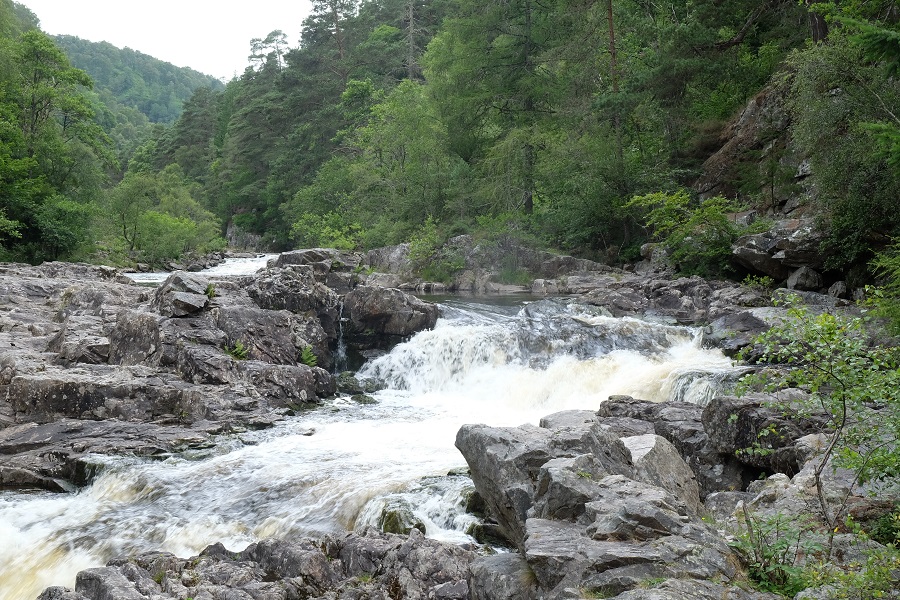
The southern end of the pass broadens out towards the confluence of the rivers Garry and Tummel. Close to this junction are the waterfalls at Linn of Tummel. These are well worth a visit. Queen Victoria clearly thought so as there is an obelisk nearby commemorating her visit to the spot in 1844. (Is there anywhere she didn’t visit?) The walk to the falls passes under the road bridge and continues along the western river bank. There are plenty of places where you can get right down to the water and yesterday paddle boarders, canoeists and swimmers were making the most of ready access to the water from extensive pebble beaches.
The falls at Linn of Tummel.
* John Graham was only around 40 when he was killed at Killiecrankie. He had served in the military since his early 20s and was recognised as a skilled leader. His relative youth and handsome face earned him the nickname Bonnie Dundee in some quarters. However, others remember him as Bluidy Clavers because of his violent suppression of covenanters in south-west Scotland. But that’s another story.
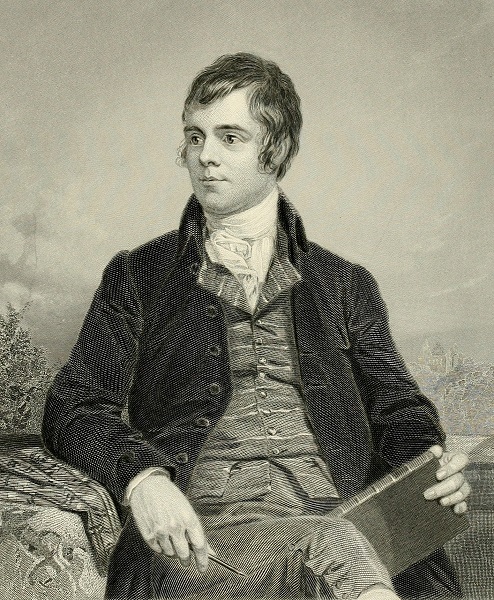
Today is poet Robert Burns’ 264th birthday and Burns suppers, with the traditional fare of haggis, champit tatties* and bashit neeps*, will be taking place this week all over Scotland and beyond. Burns was a prolific writer whose poetry ranged from railing against social injustice to sympathising with a field mouse evicted from a ploughed field, and embraced both the natural and the supernatural.
Generations of Scottish school children enjoyed (or endured) learning and reciting Burns poetry in the run up to Burns’ night. Sometimes, the challenge was simply to learn a piece of poetry in Scots, whether or not it was written by Burns. Few writers are so celebrated internationally as Burns (there are no Tennyson teas or Shakespeare suppers, after all) and Burns’ poetry is undoubtedly meaningful to, and enjoyed by, millions around the world. However, the focus on Burns overshadows other poets writing in Scots. For this reason, for many years after I had learned to recite it, I thought the short, humorous poem The Sair Finger was a Burns’ classic, when in fact it was penned by another Ayrshire-born poet, Walter Wingate.
Writing more than a century after Burns’ death, Wingate contributed poems to the Glasgow Herald among other newspapers and magazines while working as a teacher of maths in Glasgow. His work was published in anthologies but, unlike Burns, Wingate didn’t have his own book of poetry published until after his death in 1918. So here, to give Wingate his due, is The Sair Finger:
You’ve hurt your finger? Puir wee man! Your pinkie? Deary me! Noo, juist you haud it that wey till I get my specs and see!
My, so it is – and there’s the skelf! Noo, dinna greet nae mair. See there – my needle’s gotten’t out! I’m sure that wasna sair?
And noo, to make it hale the morn, Put on a wee bit saw, And tie a Bonnie hankie roun’t Noo, there na – rin awa’!
Your finger sair ana’? Ye rogue, You’re only lettin’ on. Weel, weel, then – see noo, there ye are, Row’d up the same as John!
But it wouldn’t be right to exclude Burns’ work from a post celebrating his birthday so here also is a beautiful rendition of one of his most famous love songs, A Red, Red Rose, sung by the wonderful tenor Jamie MacDougall as the soundtrack to a short film by his lovely daughter Laura MacDougall.
* Champit tatties are mashed potatoes. Bashit neeps are mashed turnips.
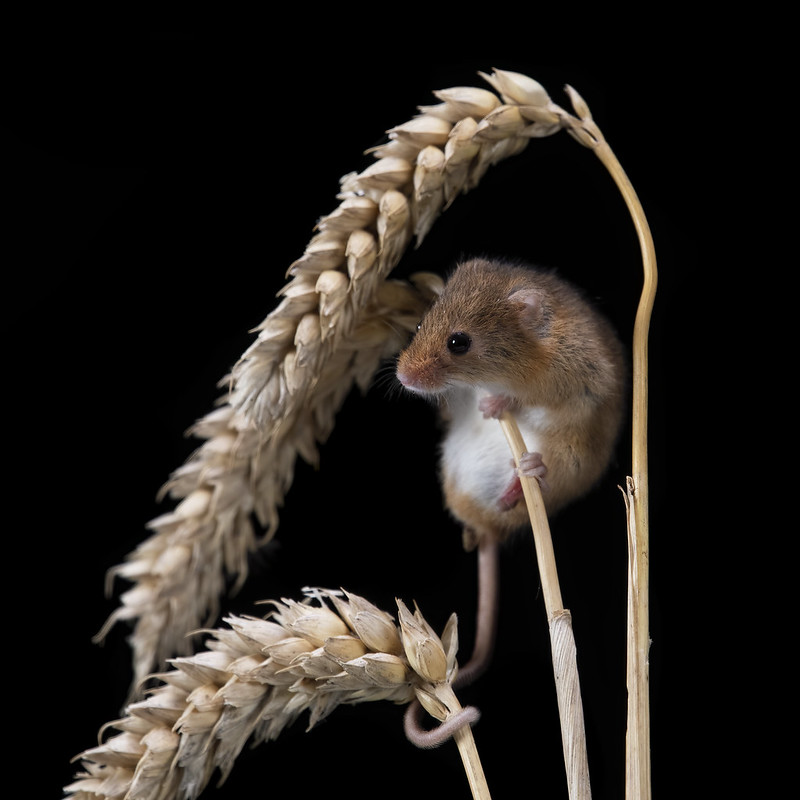
Today (July 21st) is the anniversary of Robert Burns’ death. Usually we celebrate his birthday on January 25 with Burns suppers the world over, but it seems a pity to only consider his poetry once a year. To mark the passing of Scotland’s national bard in 1796 at the age of just 37, here is a poem of his that you might not hear at a Burns supper. Burns penned songs and poems on many subjects, some rather unexpected. This one, to a mouse he found in one of his fields while ploughing, is no exception. Despite being written more than 230 years ago, some of the poem’s sentiments seem entirely in keeping with modern environmental concerns.
Hallowe’en will be a bit different this year without door-to-door guising (if you live in Scotland) or trick-or-treating but will still be an excuse for dressing up and playing games, even if it’s only with your own family.
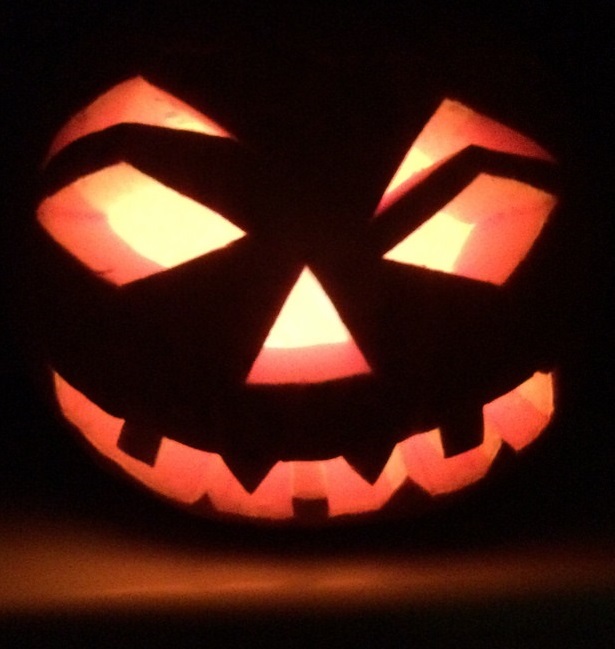
Hallowe’en was a big thing in Scotland when I was growing up. (Even the word Hallowe’en comes from the Scots term for All Hallows Eve or evening.) We dressed up, sometimes as witches, devils, fairies or other spirits but not always, and we went guising. This involved calling at the houses of friends and neighbours in our costumes (disguises) and in return for singing a song, telling a joke or a story, reciting a poem or giving some other small performance of a ‘party-piece’, guisers were rewarded with fruit, nuts, sweets and perhaps even a few coins. We took with us a Hallowe’en lantern but made them from turnips rather than pumpkins. (Turnips are much harder to hollow out.) At home or at Hallowe’en parties we also dooked for apples. For the traditionalists, dooking for apples involves floating several in a basin of water, then trying to catch one and lift it out of the basin using only your teeth. An alternative approach is to kneel on a chair with a fork between your teeth, lean over the basin of floating apples and try to spear a fruit by dropping the fork. Another favourite Hallowe’en game was trying to eat treacle-coated scones hanging from strings with our hands tied behind our backs.All very messy, but lots of fun!
The traditional Hallowe’en festivities have their origins in the Celtic festival of Samhain which marked the end of summer and the start of winter. Samhain was part harvest festival and part commemoration of the dead and was thought to be a time when the barrier between our world and ‘the other world’ was at its most permeable. The tradition of guising at Hallowe’en comes from the idea that disguising yourself as the kind of spirit which might be abroad at Hallowe’en was a way of going unnoticed among them and so offered some protection from their mischief making.
However you mark Hallowe’en this year, I hope you enjoy it and your disguises are successful!
Gaelic was a native spoken language in The Trossachs until at least the 1950s and is still evident in the place and house names in the area. The name Tigh a’ Mhaide means ‘house of the timber’ and may have been coined because of the sections of tree trunk used to support the porch at the front of the oldest part of the house.
The familiar English names of some of the most popular places to visit in the area derive from Gaelic names which are often wonderfully descriptive of the location or feature. For example:
Ben A’an comes from the Gaelic name Am Binnein meaning the pinnacle or apex. It’s easy to see why the familiar triangular peak earned its name.
Ben A’an rises above Loch Achray
Loch Achray comes from Loch Àth a’ Chrathaidh which has the intriguing meaning of Loch of the ford of the shaking.
Ben Venue comes from A’ Bheinn Mheanbh meaning the small mountain and though it may not feel like it on the long walk to the summit, Ben Venue is a mere 729m high compared to neaby Ben Ledi at 879m, or local munro Ben Lomond at 974m.
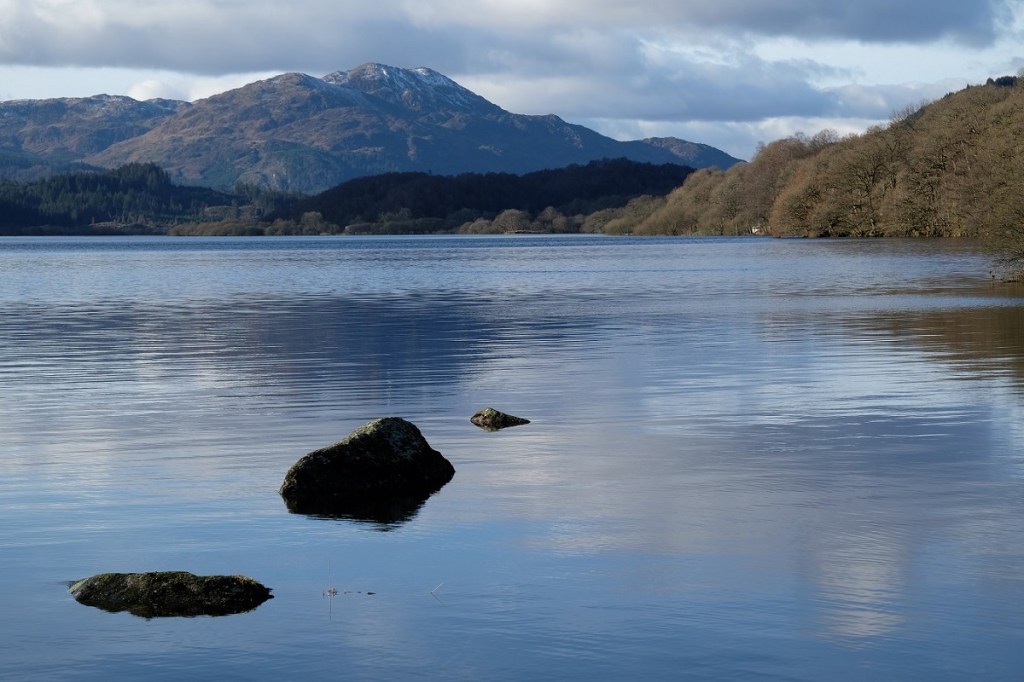
Ben Venue in the distance beyond Loch Venachar
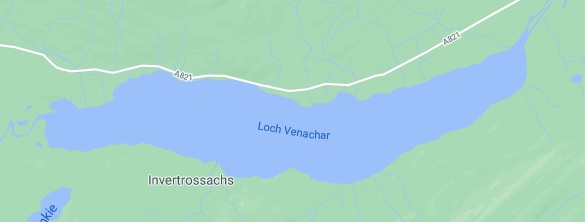
Loch Venachar’s name is from Loch Bheannchair meaning the horn-shaped or tapering loch and a look at a map shows that it’s a good description.
Gaelic may no longer be the usual native spoken language of people living in The Trossachs, but it remains an important part of the landscape and much else in the local environment and wider culture of Scotland.