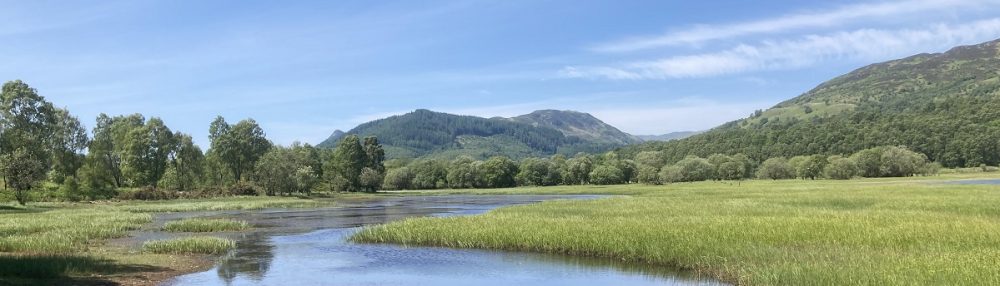
The picturesque Fife village of Falkland is dominated by the Renaissance palace that shares its name. The palace and gardens are managed by the National Trust for Scotland and make a great destination for a day out from Tigh a’ Mhaide. The palace was a favourite royal playground where Scotland’s kings and queens hunted and relaxed. More recently, the palace and Falkland village featured in the TV series Outlander, standing in for Inverness.
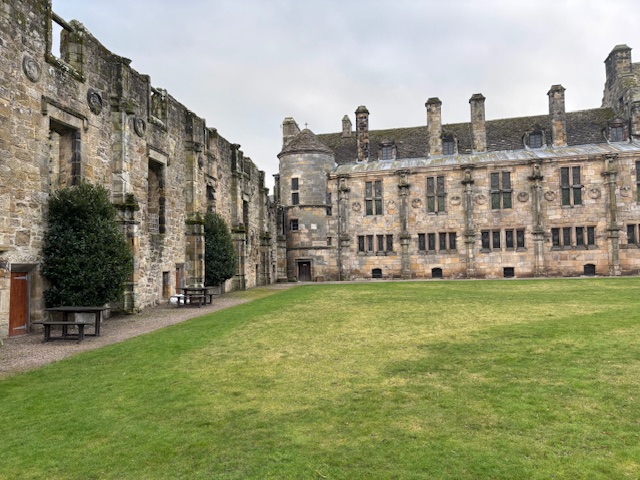
The medieval castle that preceded the palace at Falkland was a stronghold of the earls of Fife. It became the property of the Scottish crown in 1425 when Murdoch Stewart, earl of Fife at the time, was arrested, tried and executed for involvement in the gruesome murder of the heir to the throne. The murder victim was David, duke of Rothesay, who was thought to have been starved to death at Falkland by Murdoch’s father, Robert.
The medieval castle at Falkland was remodelled in the 16th century by James IV and James V who took inspiration from the great chateaux of France to create the grand Renaissance palace visible today. The French influence went further. On a visit to the royal court of France, James V was so taken by the popular game of tennis that he built himself a court at Falkland. This royal (or real) tennis court is the oldest in the world still in use. Tennis is not the only outdoor game available at the palace; visitors can also play chess or draughts.
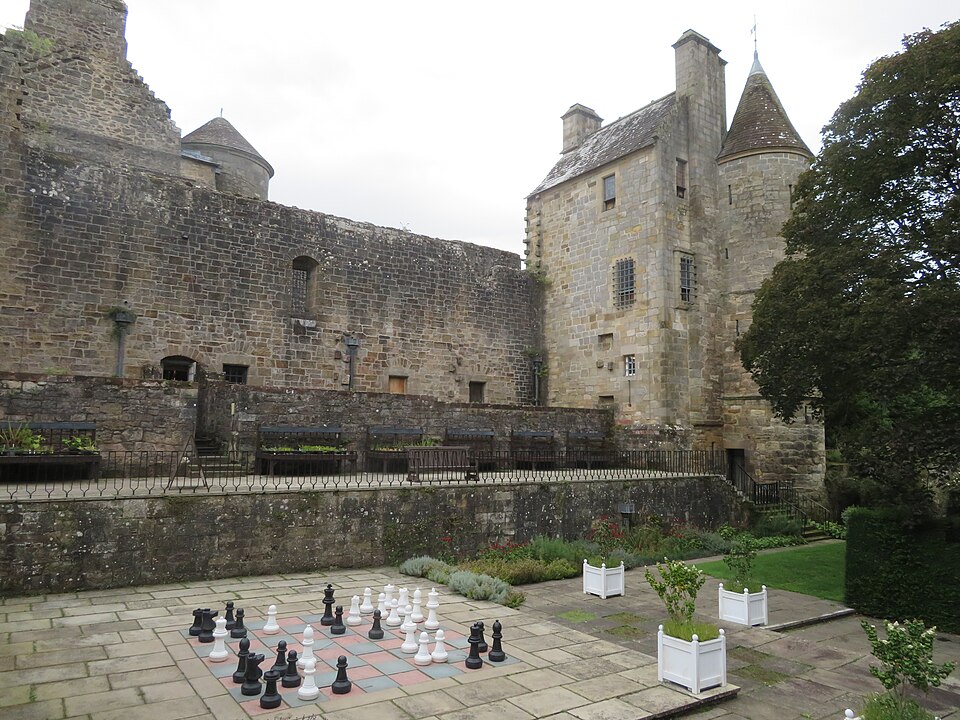
via Wikimedia Commons
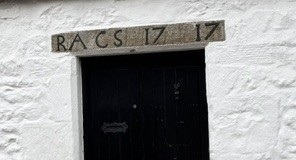
A walk round the village of Falkland is like a step back in time. The village grew up around the castle and palace. Many of the houses in the centre of the village date from the 17th century if not before and above some doorways are initials and dates. These ‘marriage lintels’ recorded the initials of a married couple and either the date of their wedding or the date they moved into the house. At this time, Scottish women retained their own surname on marriage (the custom of adopting their husband’s surname was not widespread among Scottish women until the early 20th century) so that the two sets of initials recorded the linking both of individuals and families.
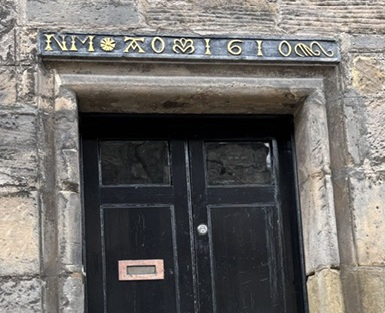
The lintel on the left above records Nicoll Moncrieff (NM) and his wife Agnes Austin (AO). The surname Austin had many spellings at this time including Ousteane and Owstyne. The couple married in 1569 so, in this case, the lintel date of 1610 records the date they built, acquired or moved into the house. Moncrieff House, as it is now known, stands on Falkland’s main street facing the palace gatehouse, and a plaque on the wall tells us more about the man who lived there.
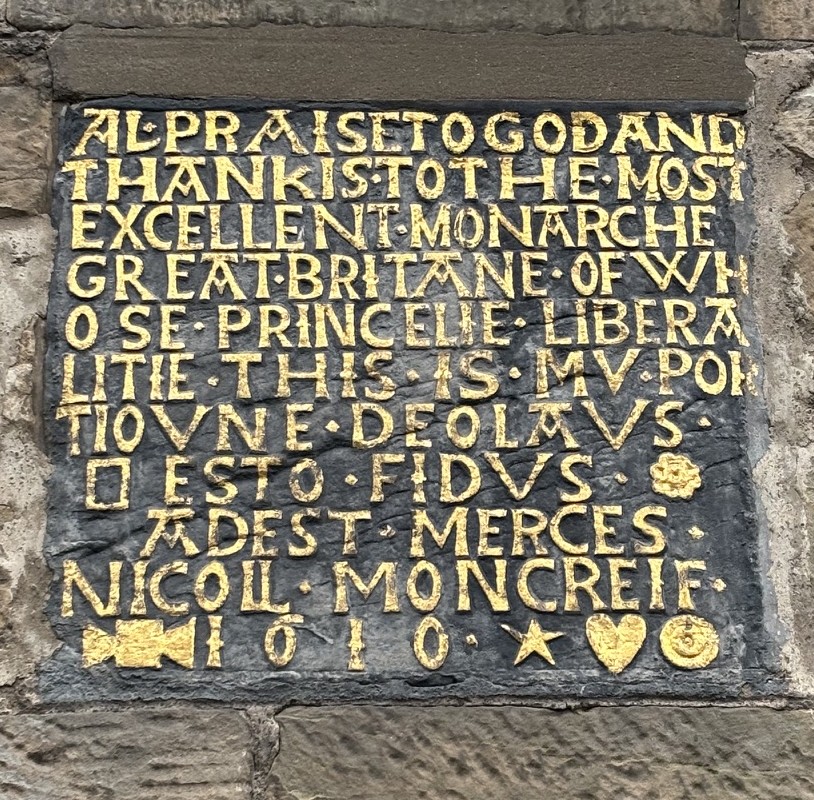
The plaque says:
“Al praise to God and thankis to the most excellent monarche [of] Great Britane of whose princelie liberalitie this is my portioune.
Deo laus. Esto fidus. Adest merces (Praise [be] to God. Be faithful. There is a reward.)
Nicoll Moncreif 1610″
The monarch in question was James VI who succeeded Elizabeth I to the throne of England in 1603 and declared that his new kingdom should be known as the kingdom of Great Britain. The wall plaque shows that Moncrieff was a valued servant of King James because the king either had the house built for him or funded Moncrieff to build it himself. Moncrieff was the king’s averiman or avenar, an officer in the royal household responsible for making sure the king’s horses were properly looked after. James returned to Scotland only once after he became king of England. In the summer of 1617, he made a three-month tour of his native land, and Nicoll Moncrieff was the man responsible for ensuring the wellbeing of the 95 horses and 33 ponies required for the visit. Moncrieff and his clerk, William Chalmer, left a detailed record of how the horses were fed, stabled and cared for. Their account shows they spent £8,000 on oats, peas and straw for the horses and a further £8,000 on stabling and “incidentals” such as 5.5 stones of iron for shoeing. That total expenditure of £16,000 is the equivalent today of over £3.5 million. Royal tours were clearly expensive.

