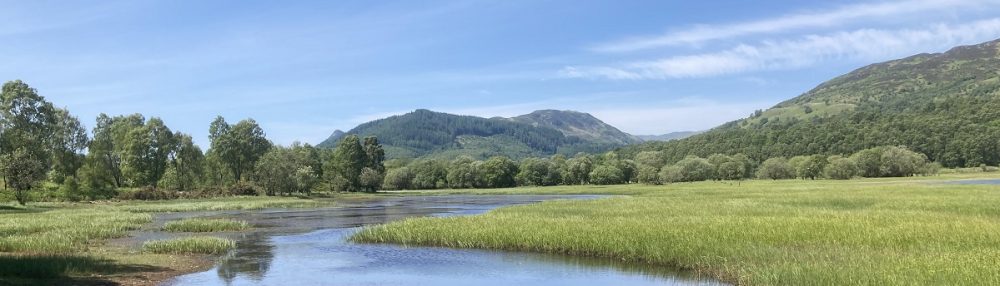
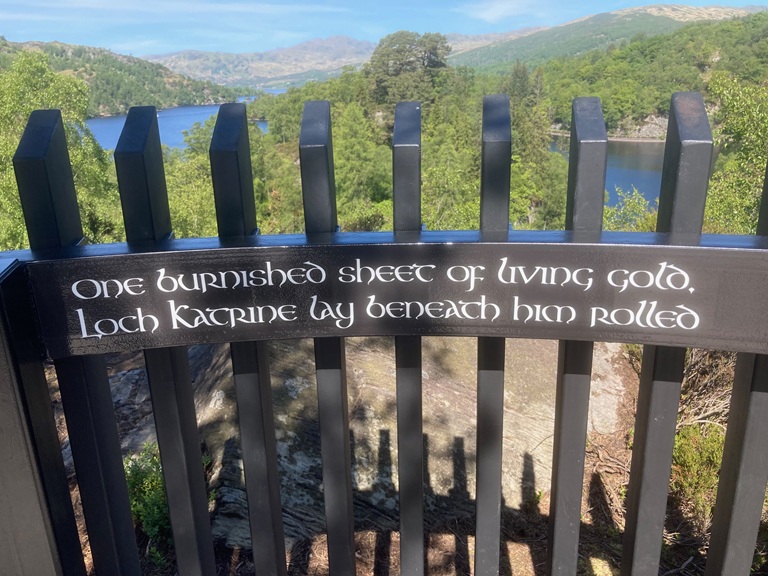
This summer was my first opportunity to visit the new lookout tower at Loch Katrine. I had the good fortune to be there on a beautiful day and it was well worth the short climb to the top. Built on three levels with information boards on the lower two and an open platform at the top for looking out over the loch and surrounding hills, the tower is near a viewpoint favoured by generations of visitors to Loch Katrine.
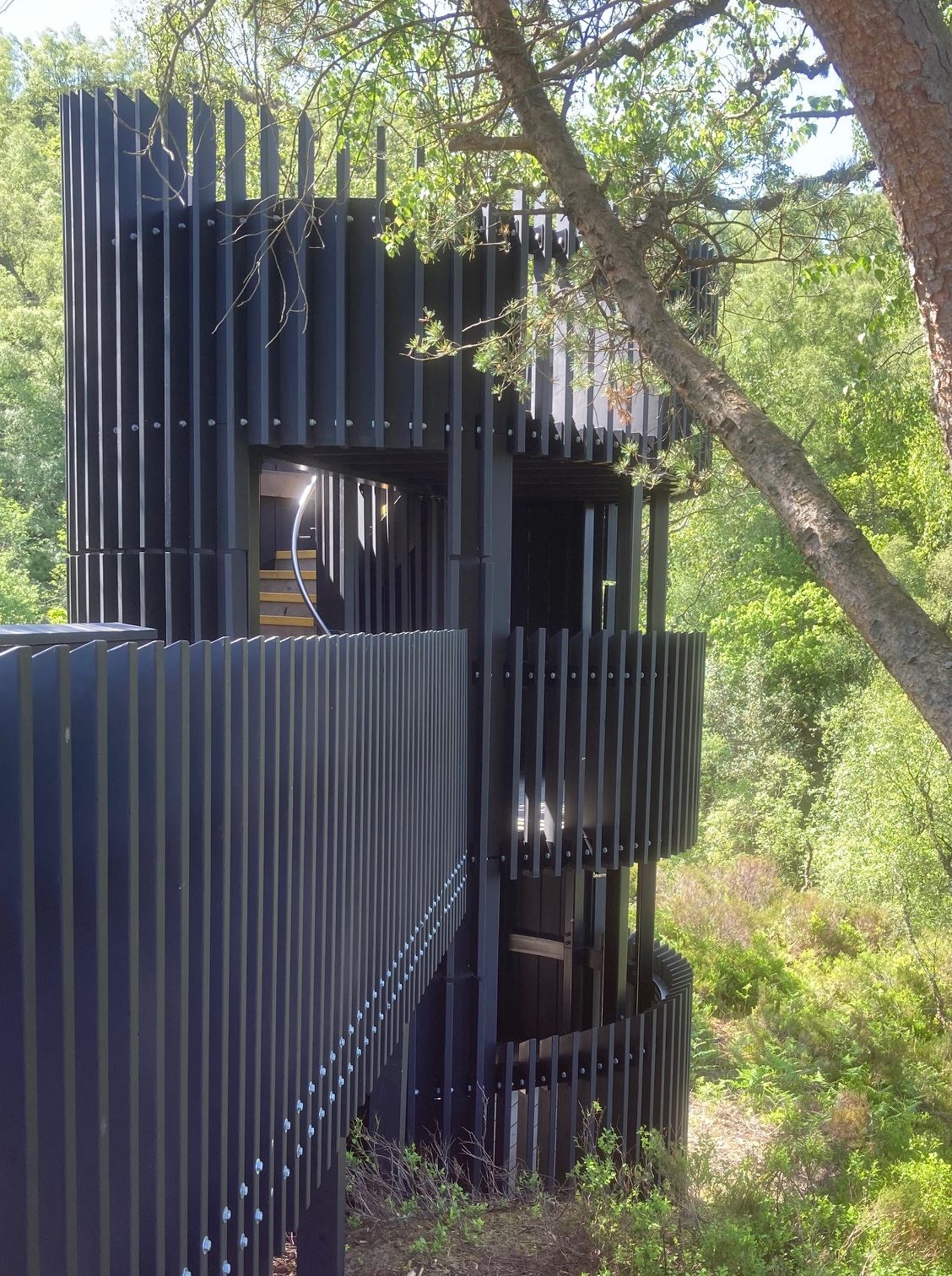
The tower is named after Roderick Dhu*, the fictional clan chief in the 1810 poem The Lady of the Lake written by Sir Walter Scott and often credited with starting tourism to Loch Katrine and The Trossachs. The tower stands on the site of a wicker hut built to shelter early tourists and intended to encourage artists and writers to visit and be inspired by the landscape.
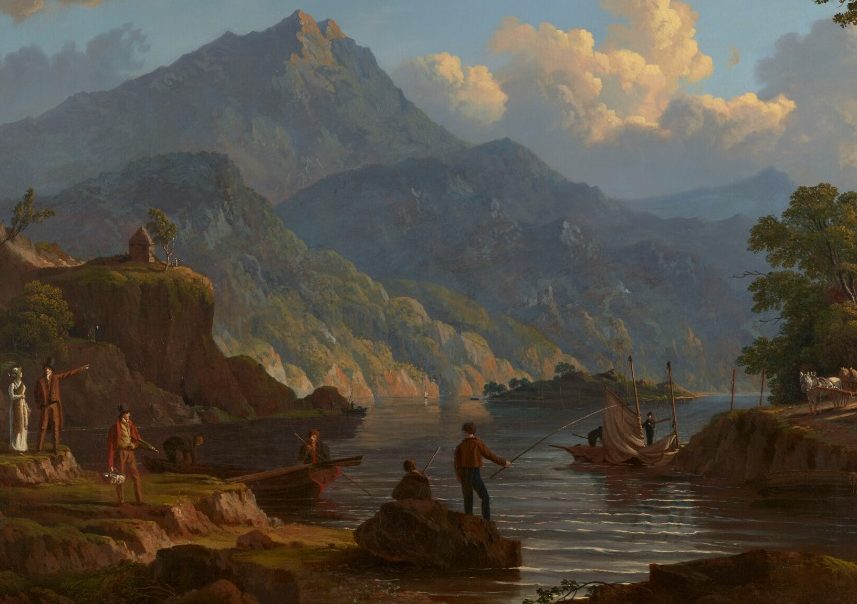
The wicker hut appears on the left in this painting, Landscape with Tourists at Loch Katrine, by John Knox, painted sometime between 1815 and 1820.
The story goes that the tower also marks the spot from which MacGregor clansmen kept watch for approaching Redcoat soldiers hunting Rob Roy in the early 1700s. Rob Roy MacGregor was a declared Jacobite, a spy, an outlaw and also, to many in the Highlands, a folk hero who consistently evaded and escaped capture until his submission and pardon in 1725.
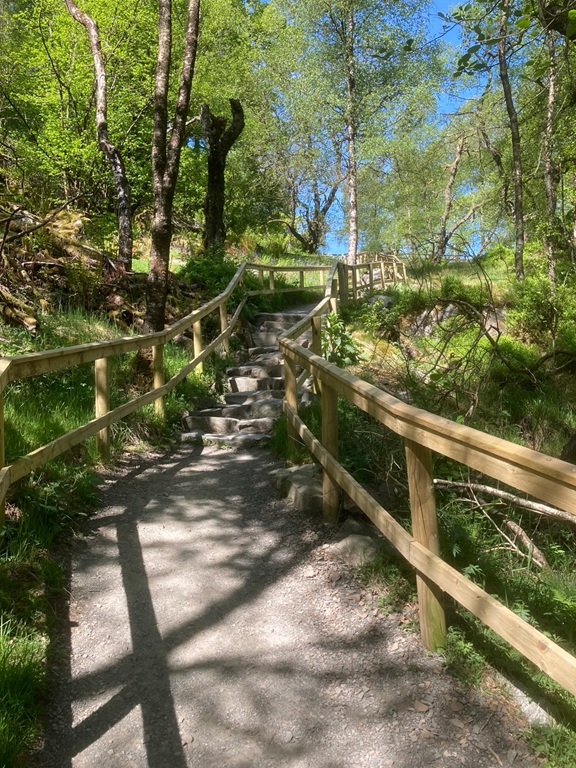
The climb to the tower starts from the Trossachs Pier car park. It isn’t a long climb but it is quite steep most of the way so there are handrails and a couple of rest places. The path wends it way through the birch and oak woods until the tower comes into view at the top.
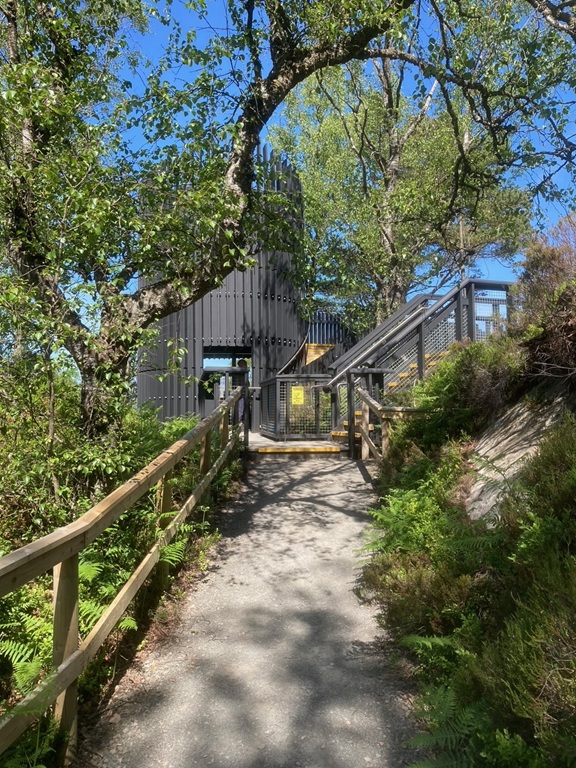
Among the information boards on the first two levels of the tower is one that might surprise visitors. It explains how Hail to the Chief, a song that has become the official anthem of the US President, originates in Scott’s Lady of the Lake. In one section of the poem, Roderick Dhu’s clansmen mark in song the arrival of their chief at Ellen’s Isle in Loch Katrine. The poem’s popularity was such that it was soon adapted for the stage, often as a musical. Theatre conductor and composer James Sanderson wrote the song of the chief’s arrival using lyrics from Scott’s poem and a Gaelic melody for the play’s production at the Surrey Theatre in London. It was first associated with a US President in 1815 when it was played in Boston to commemorate George Washington’s birthday.
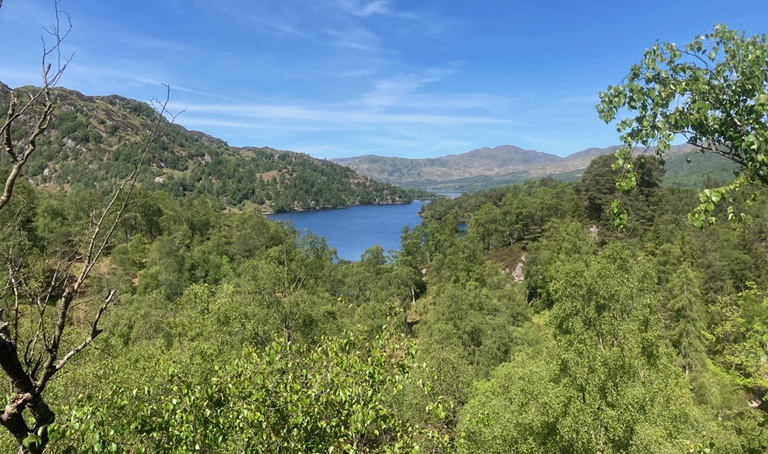
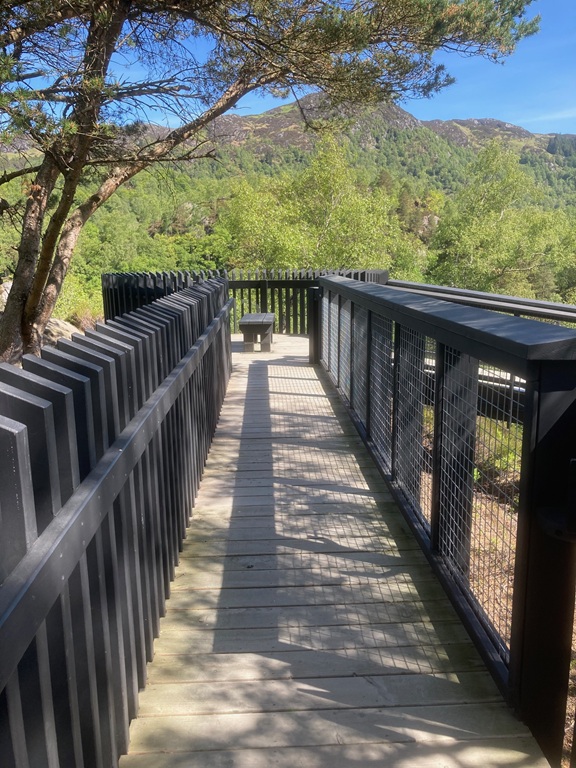
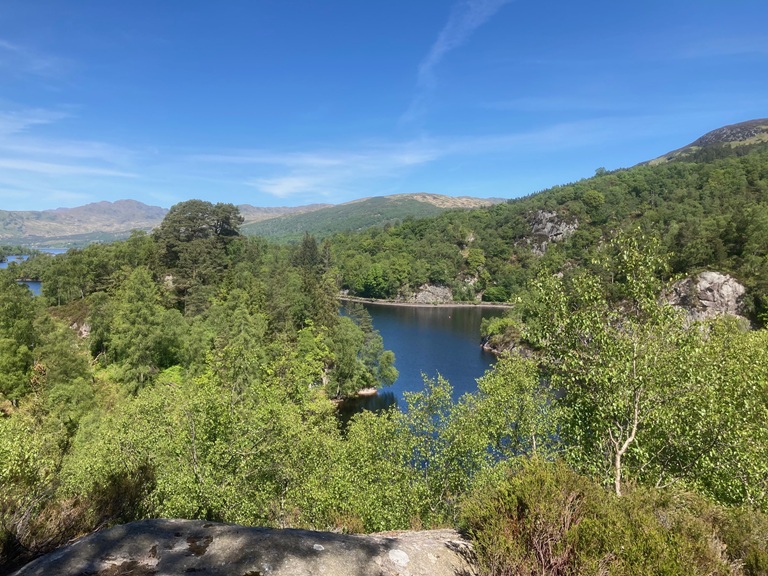
From the top deck of the watchtower you can see to the north west over the treetops along the first section of the loch. A walkway to another, lower platform and seating area gives a better view over the area of the loch immediately beyond the pier. The trees were in full leaf during my visit so that the view from the top of the tower was quite different from what early tourists would have seen from their wicker hut on a largely treeless promontory.
* Dhu comes from the Gaelic word dubh meaning black. It is pronounced a bit like the English word do. The fictional clan chief Roderick Dhu is therefore sometimes also referred to as Black Roderick. This could have been a simple reference to dark hair, but given the ruthlessness of Scott’s character, it is perhaps more likely a reference to a dark temperament or reputation.
Scott’s Lady of the Lake is widely available online. For the poem as it was originally published in 1810, see the Internet Archive. More details about Hail to the Chief are here and there’s a short biography of Rob Roy MacGregor in the Oxford Dictionary of National Biography.

